| instrument | self-use current rates ($/hr) |
|---|
| | Internal Users | External Users | Industry Users |
| GPC | $17 | $29 | $130 |
| RHEOMETER | $15 | $26 | $110 |
| SING CRYSTAL | $17 | $29 | $130 |
| FREEZE DRYER | $1 | $1.60 | $5.00 |
| 3d PRINTER | $25/FILE | $40/FILE | contact for more information |
| XRD Unit Cell | $17 | $29 | $160 |
| XRD FULL DATA | $100 | $170 | $400 |
| instrument | staff assisted current rates ($/hr) |
|---|
| | Internal Users | External Users | Industry Users |
| GPC | $57 | $75 | $210 |
| RHEOMETER | $45 | $75 | $210 |
| SING CRYSTAL | $57 | $75 | $240 |
| 3d PRINTER | | | |
| XRD Unit Cell | $57 | $75 | $240 |
| GPC | $57 | $75 | $210 |
| RHEOMETER | $45 | $75 | $210 |
| FTIR | Currently free for chemistry users | $120 | $160 |
| instrument | training current rates ($/hr) |
|---|
| | Internal Users | External Users | Industry Users |
| GPC | $57 | $75 | $210 |
| RHEOMETER | $50 | $75 | $210 |
| SING CRYSTAL | $57 | $75 | $240 |
| FREEZE DRYER | $10.00 | $16.00 | $50.00 |
| 3d PRINTER | $50/Training Session | $78.25/Training Session | $170/Training Session |
| XRD Full Data Set | $100 Sample | $100 Sample | $100 Sample |
| XRD FULL DATA | $100 | $170 | $400 |
Characterization Service
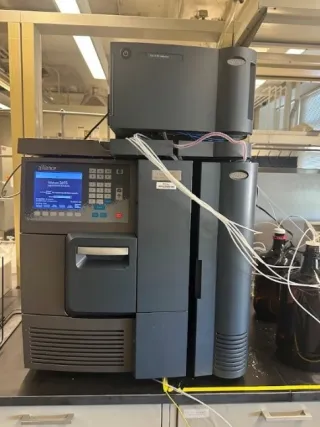
Gel Permeation Chromatography: The Waters Alliance GPC system can measure the molecular weight and molecular weight distribution of
polymers. The system includes a 2695 separations module, a 2414 refractive index detector, and a set of columns. The default solvent is tetrahydrofuran (THF), but it can be switched to dimethylformamide (DMF) upon request.
https://www.waters.com/nextgen/us/en/products/chromatography/chromatography-systems/alliance-hplc-system.html
Capabilities: polymers soluble in THF or DMF with a molecular weight range of 100 to 5,000,000.
Features:
- Autosampler
- Columns: Styragel HR2, HR4, HR5 for THF and HR4E, HR5E for DMF
- Calibration standards: polystyrene, poly(methyl methacrylate), poly(ethylene oxide)
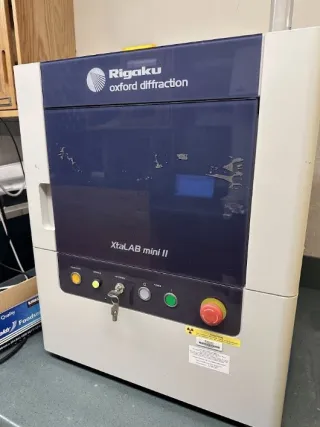
X-ray Diffraction Analysis: The Rigaku Oxford XtaLAB mini II is a research-grade, benchtop single-crystal diffractometer that offers a balance of compact size and high-quality X-ray data. Designed for synthetic chemistry labs, it provides an affordable solution for in-house structure analysis. The system is controlled by the software CrysAlisPro, which also processes the collected data. CrysAlisPro is freely available and can be installed on any Windows PC, allowing users to process data offline.
https://rigaku.com/products/crystallography/x-ray-diffraction/xtalab-mini-ii
Capabilities: organic, organometallic and inorganic small molecules with a maximum resolution of 0.66 Å
Features:
- CrysAlisPro software for automatic data processing and structure solution
- HyPix hybrid photon counting detector for precise measurements
- A high-flux X-ray source for excellent data quality
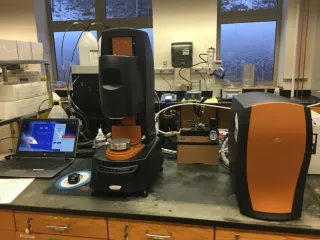
Rheometer: The TA Instruments Discovery Hybrid Rheometer-2 (DHR-2) is a high-resolution torsional rheometer designed to measure the viscoelastic properties of various materials, including fluids, gels, and elastomers. It can determine key properties such as viscosity, shear stress, storage and loss modulus, strain, and creep. The DHR-2 can perform these measurements on both liquid and solid samples, and as a function of frequency, time, temperature, and shear rate.
https://www.tainstruments.com/products/rheology/discovery-hybrid-rheometers/
Available geometries: a 20-mm diameter parallel plate
TA-DHR Getting Started Guide
RHEOLOGY- FROM LIQUIDS TO SOLIDS
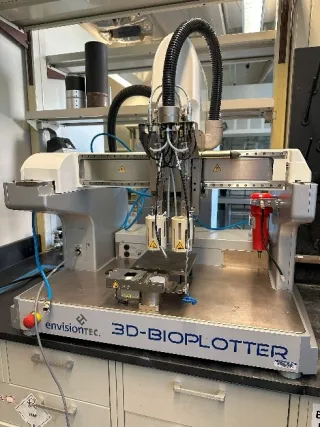
BioPlotter Developer series: It is an extrusion-based system capable of processing a wide range of biomaterials into scaffolds for biomedical applications. It creates desired shapes by dispensing a liquid material from a syringe using air pressure, while the syringe moves precisely in three dimensions. The printer is equipped with two dispensing heads that can accommodate both high- and low-temperature cartridges and materials.
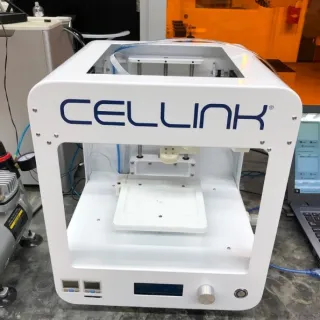
Cell Link 3D Printer: It is an extrusion-based bioprinter designed to provide bioengineers with the flexibility to work with a wide range of biomaterials. This capability allows for more relevant and advanced tissue engineering applications. It offers a build volume of 150 × 150 × 100 mm. Resolution
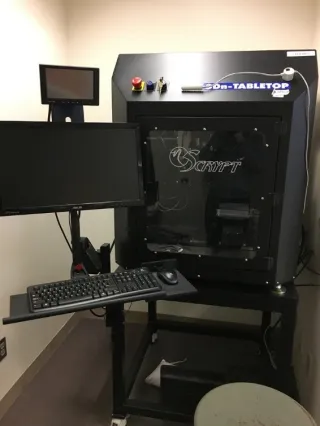
nScrypt Tabletop 3D Printer: The 3Dn Series Factory in a Tool (FiT) offers cutting-edge technology, with a powerful and robust high-speed, high precision motion platform tailored for 3D manufacturing. Its versatility surpasses conventional standards by seamlessly producing complete products rather than just individual parts.
The system effectively manages and synchronizes multiple tool heads either in series or in parallel, ensuring seamless operation and unparalleled efficiency.
3Dn-TableTop Brochure
nScrypt Software Manual
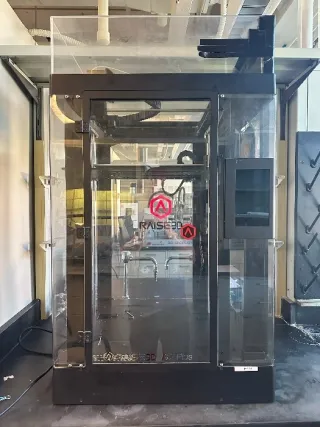
Raise 3D N2 Plus: It is a large-bed filament printer featuring a substantial build volume of 305 x 305 x 610 mm (12 x 12 x 24 in). It has a 7-inch full-color touchscreen for complete device control, as well as for monitoring and fine-tuning prints in progress. This printer comes standard with a heated bed and a V2 Hot End that can reach temperatures up to 300°C. It is compatible with a wide range of commercially available polymer materials, including PLA, ABS, PETG, and Nylon.
Filament Size: 1.75mm
Filament Type: PLA, ABS, PETG, Nylon, Carbon Fiber, TPU/TPE (Flexibles)
Nozzle Diameter: 0.4 mm (0.016 in)
Nozzle Working Temperature: 170-300 ℃
Number of Nozzles: 1
Printing Speed: 10 ~ 150 mm/s
Moving Speed: 150 ~ 300 mm/s
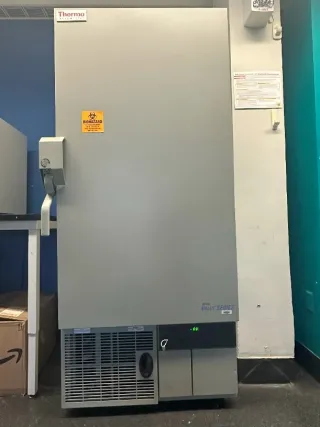
Ultra-low temp freezer: The -80C freezer serves as a backup freezer for use when labs in the chemistry department are defrosting their freezer or when they need temporary storage while a freezer is being repaired. It is not to be used for long-term overflow storage.
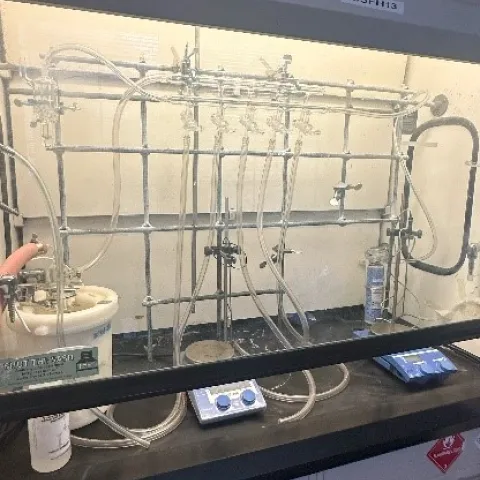
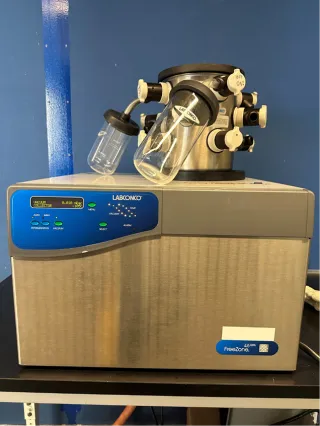
Labconco Freeze Dryer: The FreeZone 4.5 Liter Cascade lyophilizer is a high-performance, benchtop freeze-dyer equipped with an oil vacuum pump. It is specifically designed for lyophilizing light sample loads containing organic solvents at -105 °C. Its stainless-steel drying chamber has 12 manifold ports with12 valves. Each valve has a beveled edge to provide at-a-glance indication of whether the valve is open or closed. The clear acrylic lid permits easy monitoring of ice build-up on the collector.
Please adhere to the following guidelines: Samples should be fully frozen in water with liquid nitrogen before being transferred into fast-freeze flasks. The system can handle trace amounts of acetonitrile, methanol, ethanol, acetone, and DMSO. Chloroform and CH2Cl2 are not allowed. Corrosive substances should be not be processed in this unit.
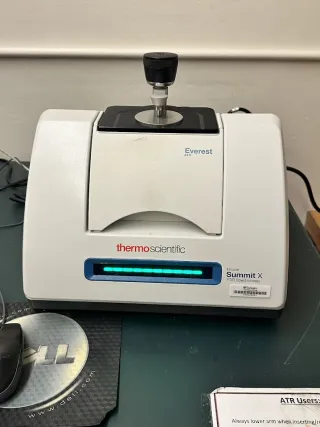
FTIR: Nicolet™ Summit™ X FTIR Spectrometer is a compact, easy-to-use, high-performance spectrometer for material characterization. Its LightDrive Optical Engine ensures exceptional data reproducibility and reliability. Its advanced infrared source eliminates hot spot migration, ensuring consistent spectral results—especially when paired with Attenuated Total Reflectance (ATR) accessories. Both Everest ATR accessary is available for rapid, non-destructive surface analysis in ATR mode. iD1 transmission accessary is available for traditional thin-film or pellet measurements in transmission mode. The integrated OMNIC Paradigm Software enables users to easily process their spectra, creates customized workflows, and performs multi-component searching.
| Beam Splitter | KBr/Ge mid-infrared optimized |
| Components | LightDrive Optical Engine components: source, laser, interferometer and detector |
| Detector Type | Fast-recovery deuterated triglycine sulfate (DTGS) |
| Measurement Mode | ATR (Everest Diamond); Transmission (iD1) |
| Type of Samples | Solids, liquids and gases |
| Spectral Range | 8000 to 350 cm-1 optimized, mid-infrared KBr beamsplitter |
| Spectral Resolution | 0.6 cm-1 |
FTIR MANUALS:
OMNIC PARADIGM USER GUIDE
EVEREST ATR ACCESSORY USER GUIDE
measure a sample
measure the background